
Why preparedness, practical skills, community, and faith belong together.

When people hear the term self-reliance, they sometimes picture someone living alone in the wilderness, disconnected from society, determined never to need help from anyone.
Others hear it as a philosophy that says, “I don’t need anybody. I can handle everything myself.”
And for Christians, that can raise an even more important question: If we’re supposed to rely on ourselves, where does that leave our reliance on God?
Those are fair questions.
But that’s not what self-reliance means to us at Patriot Reliance.
We believe there’s a big difference between refusing to depend on other people and reducing our dependence on systems that aren’t always dependable.
We believe in the importance of our neighbors, families, and communities, and we appreciate the conveniences of modern life. But we also believe there’s wisdom in being prepared when the systems we’ve come to depend on aren’t available.
And perhaps most importantly, we believe that becoming more capable ourselves puts us in a better position to help others.
That’s the kind of self-reliance we want to encourage.
When Convenience Becomes Dependence
Think about your local grocery store.
We live in an incredible time. We can walk into a store and find fresh produce, meat, bread, and just about anything else we might need. Most of us rarely think about everything happening behind the scenes to keep those shelves stocked.
But many modern supply chains rely heavily on what’s known as just-in-time inventory. Rather than maintaining enormous amounts of stock at every location, businesses depend on frequent deliveries to replenish what customers purchase.
It’s efficient, reduces waste, and generally works very well.
Until something interrupts it.
A hurricane, winter storm, transportation disruption, or even a sudden increase in demand can empty shelves surprisingly quickly.
We’ve all seen examples of this happening.
Now, does that mean grocery stores are bad? Of course not. We’re thankful for them.
But perhaps we shouldn’t have to depend on a grocery store being open and fully stocked to feed our families tomorrow.
Keeping a well-stocked pantry, growing a few vegetables, learning to prepare meals from basic ingredients, or knowing how to preserve food aren’t radical ideas.
They’re ordinary skills that many generations before us practiced as part of everyday life.
And those skills are still valuable today.
Being prepared doesn’t mean expecting the worst. It means recognizing that the unexpected is part of life.

Our Dependence Goes Far Beyond Grocery Stores
Food is just one example.
Think about how much of our daily lives now depend on technology working exactly as expected.
We rely on our phones to communicate, electronic payment systems to purchase necessities, online banking to manage our finances, GPS to find our way, and cloud-based services to keep businesses operating.
Even our access to important records, instructions, photographs, and personal information increasingly depends on computers and internet connections.
I work with technology, and I appreciate just how useful these systems are.
But I also recognize how many things can be affected when one of them stops working.
A software problem, equipment failure, power outage, or interruption at a major service provider can have consequences far beyond the original problem.
Suddenly, people may have trouble making purchases, accessing information, communicating, or conducting ordinary business.
And here’s the concerning part: We can become so accustomed to having these services available that we forget how to function without them.

That doesn’t mean we need to reject technology.
Quite the opposite. Technology can be an incredibly valuable part of preparedness. Modern weather forecasting, emergency alerts, communication equipment, and countless other innovations help keep us informed and safe.
But relying entirely on one technology or system leaves us vulnerable when it fails.
Consider a few simple precautions:
- Keeping a reasonable amount of cash available in case electronic payment systems aren’t working.
- Maintaining printed copies of important phone numbers, addresses, and emergency information.
- Having flashlights, batteries, and other essential supplies ready before a power outage.
- Learning alternative communication methods, such as amateur radio, where appropriate.
- Keeping basic information and useful reference materials available offline.
- Knowing how to accomplish everyday tasks without always needing an app, website, or internet connection.
None of these require us to abandon modern life.
They’re simply ways to make ourselves a little less vulnerable to interruptions.
The goal isn’t to live without modern conveniences. It’s to remain capable when those conveniences aren’t available.
Self-Reliance Is About Responsibility, Not Isolation
We don’t believe anyone can, or should, do everything themselves.
We need farmers, doctors, electricians, teachers, mechanics, and countless others who contribute their knowledge and abilities to our communities.
We need family, friends, neighbors, and churches.
And sometimes, regardless of how well we’ve prepared, we’re going to need someone else’s help.
There’s nothing wrong with that.
But there’s also tremendous value in learning to do the things we reasonably can for ourselves.
Knowing how to repair something rather than immediately replace it.
Learning to cook meals from basic ingredients rather than depending entirely on prepared food.
Understanding how to maintain essential equipment.
Developing the skills to handle an unexpected problem instead of always waiting for someone else to solve it.
These things build confidence, save resources, and give us more options when life doesn’t go according to plan.
They can also create opportunities to teach our children and grandchildren skills that might otherwise be forgotten.
We’re not suggesting everyone needs to become a farmer, mechanic, electrician, and carpenter.
And certain jobs absolutely belong in the hands of qualified professionals.
But there’s a healthy middle ground between doing everything yourself and being completely dependent on others for even the simplest tasks.
That’s where we believe practical self-reliance belongs.
The More Prepared We Are, the More We Can Help
Here’s something that often gets overlooked when people discuss preparedness:
The better prepared we are, the more capable we may be of helping someone else.
Imagine a storm knocks out electricity across your community.
One family has a few days of food, drinking water, flashlights, and a way to receive important information.
Another family wasn’t expecting the outage and has none of those things.
The first family may be in a position not only to care for themselves, but also to check on their neighbors, share supplies, or lend a helping hand.
That’s the kind of self-reliance we believe in.
Not independence from our neighbors, but the ability to be better neighbors.
Not accumulating supplies simply to protect ourselves, but preparing wisely so we may be able to help others when the opportunity arises.
Sometimes helping a neighbor means lending a tool or fixing something that’s broken.
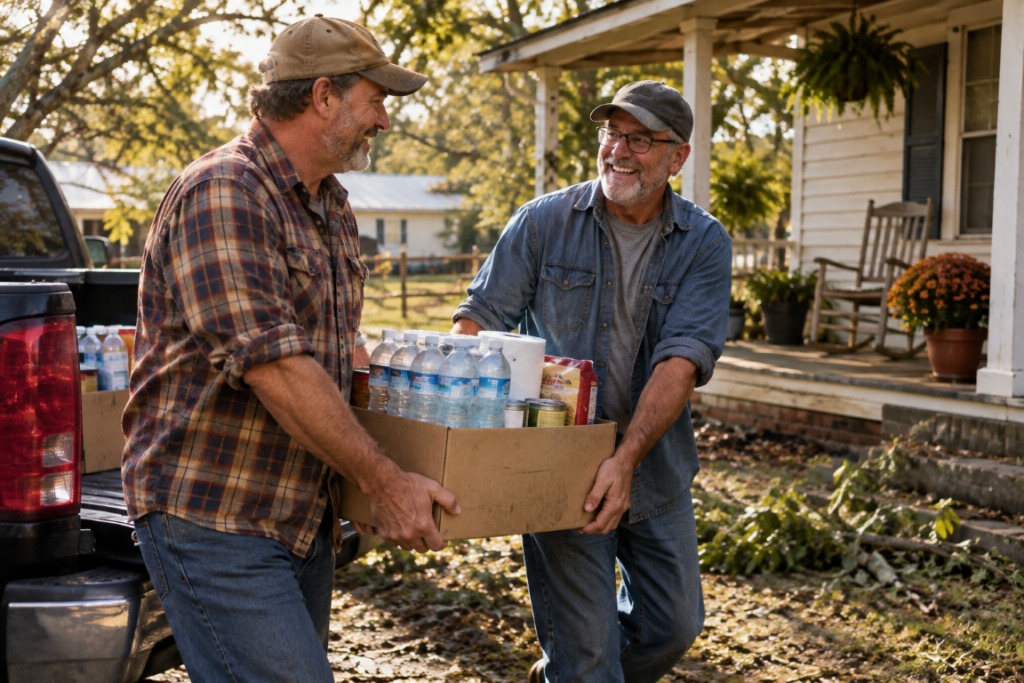
Sometimes it means sharing food, checking on an elderly resident after a storm, or teaching someone a useful skill.
And sometimes it means recognizing that we’re the ones who need help and allowing someone else the opportunity to serve.
Strong communities aren’t built by people who never need one another.
They’re built by people who are willing and able to help one another.
The goal isn’t just to become less dependent. It’s to become more dependable.
Where Does God Fit Into Self-Reliance?
This is perhaps the most important part of our philosophy.
As Christians, we believe there’s nothing contradictory about taking responsibility for our families, preparing wisely, and trusting God.
In fact, we believe these principles complement one another.
Proverbs 21:20 speaks of the wisdom of storing up provisions rather than consuming everything we have.
That’s a valuable reminder that planning ahead and managing our resources responsibly are worthwhile practices.
But Scripture also tells us in Galatians 6:2 to bear one another’s burdens.
Those two principles belong together.
Prepare wisely. Help generously.
We believe God has given us abilities, opportunities, resources, and responsibilities. Learning to use those gifts wisely is part of being good stewards of what we’ve been entrusted with.
But there’s an important distinction between being responsible and believing we’re completely in control.
No amount of food storage, equipment, money, or knowledge can guarantee that life will go according to plan.
There will always be things beyond our ability to anticipate or overcome.
And that’s why our ultimate reliance isn’t on our preparations, our possessions, or even our own abilities.
Our ultimate reliance is on God.
We prepare because we believe it’s wise to be responsible with what we’ve been given.
We help others because we believe we’re called to love and serve our neighbors.
And we trust God because we recognize that our own strength and understanding will never be enough for everything life brings.
To us, that’s not a contradiction.
It’s the proper balance.
Preparedness Isn’t Just About Disasters
When people talk about preparedness, the conversation often turns to hurricanes, major emergencies, widespread power outages, or even the possibility of society breaking down.
And while some of those possibilities are worth considering, they’re not the only reasons to develop practical skills and build resilience into our lives.
Sometimes the emergency is much more personal.
A job loss.
An unexpected medical expense.
A broken appliance.
A temporary loss of income.
A vehicle that won’t start.
A storm that keeps the family home for several days.
Being able to stretch groceries into more meals, repair something instead of replacing it, or draw on supplies we’ve already set aside can make a tremendous difference during difficult times.
But even when everything is going well, these skills are valuable.
Learning to garden can provide fresh vegetables and a rewarding hobby.
Cooking from scratch can save money and bring a family together.
Learning woodworking, leathercraft, sewing, or basic repairs can provide useful items and a sense of satisfaction.
Understanding how things work can make us better problem solvers.
And teaching those skills to the next generation helps preserve practical knowledge that might otherwise disappear.
Self-reliance isn’t something we practice only when things go wrong.
It’s a way of approaching everyday life with a little more responsibility, resourcefulness, and purpose.
Why We Started Patriot Reliance
When we chose the name Patriot Reliance, the word reliance had three important meanings.
1. Reliance on Trustworthy Products and Information
We want Patriot Reliance to be a name people can trust.
That means creating practical, useful products, sharing worthwhile information, and taking pride in the things we make.
Whether it’s a simple household accessory, a useful reference card, or something personalized for a special occasion, we want our creations to have genuine value to the people who receive them.
Not everything has to be complicated or expensive to be worthwhile.
Sometimes the simplest things serve the greatest purpose.
2. Reliance on the Skills and Resources We Develop
We believe in learning useful skills, working with our hands, planning ahead, and becoming better prepared for the challenges of everyday life.
Not so we can separate ourselves from others, but so we can become more capable of providing for our families and helping our communities.
We’re not trying to eliminate our need for other people.
We’re trying to avoid unnecessary dependence on systems that may not always be available.
And in doing so, we hope to become people others can depend on.
3. Reliance on God
Above everything else, we believe our faith should be the foundation of what we do.
Our products, skills, and preparations are useful, but they aren’t the ultimate source of our security.
We want to build a business that reflects our Christian values through the way we work, the things we create, and the way we treat others.
Part of that commitment includes dedicating at least 10% of our business profits to Christian charitable causes.
It’s one small way we hope to turn the work of our hands into something that benefits others.
These three principles are the foundation of what we’re building at Patriot Reliance.
And while we’re still learning and growing, they’re the values we want to carry forward.
Some Things Are Worth Holding On To
We don’t want to turn back the clock or abandon the conveniences of modern life.
We’re grateful for the advances that make so many things easier.
But we also believe some of the knowledge, habits, and values of earlier generations are worth preserving.
Knowing how to make something.
Knowing how to fix something.
Having enough on hand to weather an unexpected interruption.
Taking responsibility for our families.
Looking out for our neighbors.
Passing useful knowledge to our children and grandchildren.
And recognizing that, through it all, our ultimate trust belongs in God.
These aren’t outdated ideas.
They’re practical principles that can still make a real difference in our lives today.
That’s the heart of what we’re trying to build with Patriot Reliance.
We’re not interested in encouraging people to live in fear of what might happen tomorrow.
We want to encourage people to live with greater confidence, responsibility, generosity, and faith today.
Because in the end, self-reliance isn’t about needing nobody.
It’s about becoming more capable of caring for ourselves, better prepared to care for others, and wise enough to recognize where our ultimate reliance belongs.
Patriot Reliance
Prepared to provide. Equipped to serve. Grounded in faith.